About Hexpack
Hexpack is an adaptation of piecepack. The hexpack is a public domain game system designed to encourage creative, open game development and design.
 |
 |
Designers
The Hexpack was designed by Daniel Wilcox and Nathan Morse.
BoardGameGeek Page
The hexpack page on BoardGameGeek
Short Definition
A standard hexpack is a set of 24 tiles, 48 coins in 4 suits and 6 values, designed to be used with a standard piecepack.
- 6 hexes
- 12 triangular chits (one set suited, one set with blank backs) - valued blank, ace, 2, 3, 4, 5 - in each of 4 different suits:
- suns
- moons
- crowns
- arms (fleur-de-lis)
Long Definition
Colors
Standard Color Associations:
- Arms are blue
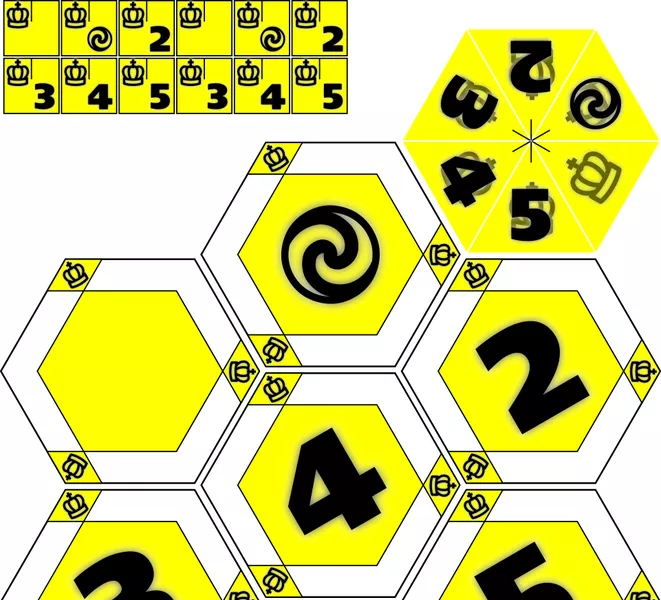
- Crowns are green or yellow
- Moons are black
- Suns are red
Components
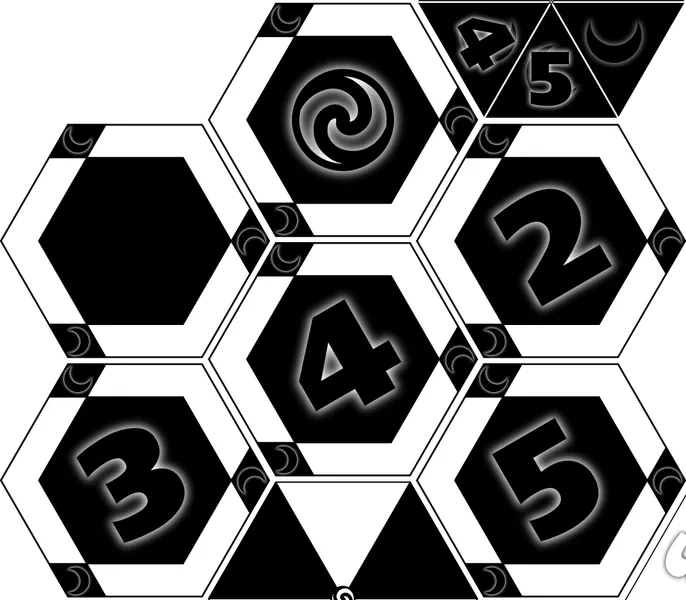
24 hexagonal tiles:
- one per suit/value pair
- suits are Suns, Moons, Crowns, Arms
- values are null, ace, 2, 3, 4, 5
- faces are marked with value at center and small suit symbols at the corners, both colored with the suit color
- suit backs are marked with black crosses to suggest division into equilateral triangles
24 triangular chits:
Analogous to piecepack coins
- one tile per suit/value pair
- suits are Suns, Moons, Crowns, Arms
- values are null, ace, 2, 3, 4, 5
- faces are marked with value in black (aces are a generic symbol, such as a spiral)
- backs are marked with suit in the appropriate color
- both fronts and backs are marked with a small mark near the top edge for directional indication.
24 additional triangular chits:
These chits are experimental and are intended for use in tiling the hexes. Using them mixed together with the primary chits could cause some confusion.
- one tile per suit/value pair
- suits are Suns, Moons, Crowns, Arms
- values are null, ace, 2, 3, 4, 5
- faces are marked with value,a suit, and a directional indicator
- backs are unmarked
4 d6 dice:
cubic - typically provided by a standard piecepack
- one die per suit
- suits are Suns, Moons, Crowns, Arms
- values on each die are null, ace, 2, 3, 4, 5
- die sides are marked with value in color to match suit and possibly a directional indicator.
1 d6 suit selection die:
cubic - optional
- one d6 is a suit indicator marked with one of each suit, a null, and an ace. All sides have directional indicators.
4 pawns:
non-specific shape - typically provided by a standard piecepack):
- one pawn per color
Size of pieces
The hexpack is very specifically designed to work with and extend a standard piecepack. A typical piecepack has tiles that are 2"×2", which perfectly accommodates use of Icehouse pieces, in addition to the standard piecepack pawns and dice. Similarly, a typical hexpack has tiles that circumscribe a circle with a 2" (~50mm) diameter - which is to say that the distance between sides of a tile is 2". This size was chosen specifically to allow use of Icehouse Pieces, but also to allow even the large Icehouse pyramid to be laid on its side on a tile, to indicate directionality or vectors.
Notes for Manufacturers
The hexpack is public domain. Anyone may manufacture and distribute (for profit) hexpacks without royalty or license.
Hexpacks may certainly (and should be) stylized or personalized. It is merely for compatibility that they conform to the basics outlined in the section above.
Though not required, you may include the names of the designers of the hexpack, Nathan Morse & Daniel Wilcox, as part of hexpack packaging.